In Ferrara, I was struck by a dramatic change in weather. Having descended from the mountains, I was quickly greeted by an early-spring landscape. The city itself, less exuberant than other parts of Emilia-Romagna, has a landscape that feels much closer to the melancholic scenery of Poland.
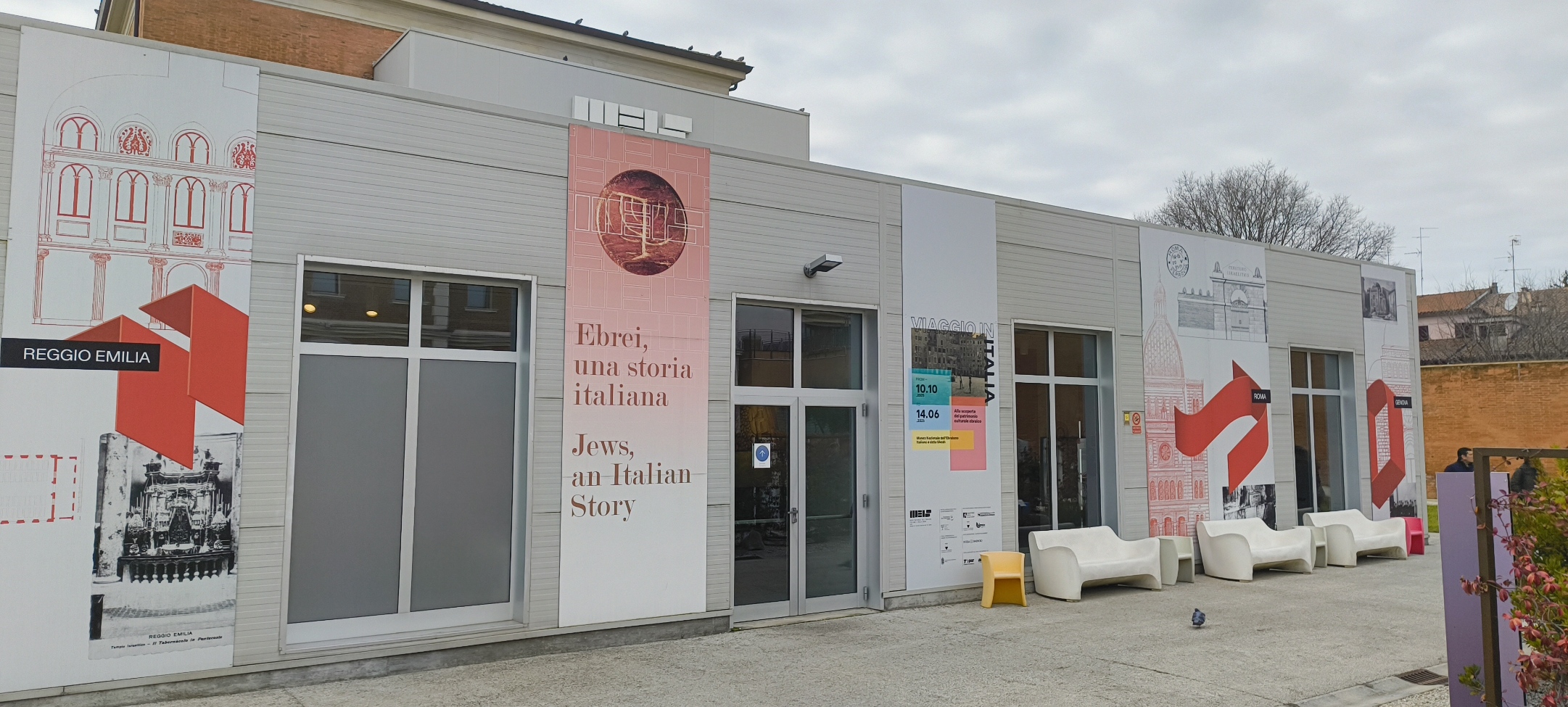
Ferrara is usually associated with Renaissance architecture, the d’Este family’s castle, and, for those interested in history, the endless annals of wars, rivalries, and feuds among the region’s wealthy families. I, however, came here with one very specific purpose: to finally visit MEIS – the National Museum of Italian Judaism and the Shoah (Museo Nazionale dell’Ebraismo Italiano e della Shoah).
MEIS is not housed in a traditional Renaissance palace, of which Ferrara has no shortage, but in a former prison building dating from the beginning of the twentieth century. A space that during the Fascist era had served to isolate and oppress people whom the regime considered “antisocial” and harmful to society has been revitalized and transformed into an open place of remembrance and culture.
Before you enter the main building itself, however, you are greeted by something lighter: the “Garden of Questions” (Giardino delle Domande) – a small labyrinth filled with biblical plants, explaining the principles of Jewish kashrut.
„Ebrei, una storia italiana” – From the Destruction of the Temple to the Dawn of the Middle Ages
The unexpected highlight of my visit turned out to be the exhibition Ebrei, una storia italiana. I primi mille anni (Jews, an Italian Story: The First Thousand Years). Having arrived with a focus primarily on wartime history, I did not expect to encounter such an extensive permanent exhibition devoted to the early history of Italian Jews. Italy is probably the only place in the Western diaspora where Jewish presence has remained virtually uninterrupted for more than two thousand years, and the exhibition takes us on a journey that begins in ancient Jerusalem.

As we move through the first galleries, we reach the year 70 CE and the destruction of the Second Temple by the Romans. Particularly impressive is the reproduction of the Arch of Titus in Rome, showing Roman soldiers carrying the spoils of war from the Temple, including the enormous menorah. These spoils were subsequently used to help finance the construction of the Colosseum.
The exhibition then takes us to ancient Rome, where we learn about as many as eleven different Jewish communities, each with its own synagogue. The museum’s curators have done an excellent job of bringing this period to life through a carefully selected collection of artefacts.
Here we find fragments from Jewish catacombs, such as those at Monteverde and Villa Torlonia, showing how early Jewish communities buried their dead in the heart of the Empire. The exhibition also focuses on the Constitutio Antoniniana of 212 CE, which granted Roman citizenship to all free inhabitants of the Empire, including Jews, thereby changing their legal and social position.
What is perhaps most striking about this section of the museum, however, is the collection of genuine artefacts displayed in tall, dimly lit galleries. More than 200 objects include Roman and medieval inscriptions, gold signet rings, faded but still legible ancient coins, and clay oil lamps bearing menorah motifs.
We can also see manuscripts, precious incunabula, early printed books, and unique amulets.
With the fall of Rome, the story continues. We move into the Early Middle Ages, following Jewish migration toward the southern Italian peninsula. The exhibition shows how Jewish communities lived under Lombard and Byzantine rule and, later, under Muslim rule in Sicily, while experiencing remarkable cultural and economic flourishing. Jews became pioneers in medicine, astronomy, and trade, and played an important role in translating ancient Greek and Arabic texts.
Northern Italy and the Golden Age in Ferrara
The next section of the exhibition takes us to northern and central Italy, showing that Italy was never a monolith and that Jewish communities in individual city-states developed in very different ways, creating a unique mosaic of traditions, dialects such as Judeo-Italian, and customs.
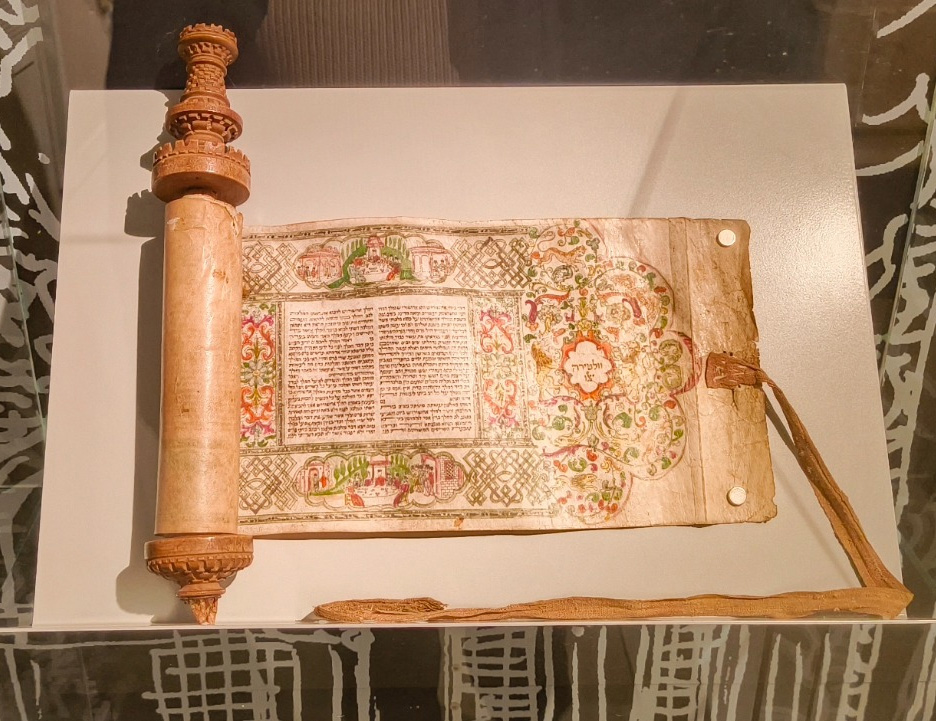 When visiting Ferrara, it is of course worth taking a closer look at the history of its Jewish community. The history of the Jews of Ferrara is, in many respects, a true roller coaster, ranging from hospitality to brutal segregation. The first references to Jewish settlement date back to the twelfth century. A more established community began to take shape in the early thirteenth century, when bankers and moneylenders from Rome and central Italy arrived in the city, settling around what is now Via Centoversuri.
The exhibition describes the golden age that arrived in the fifteenth century with remarkable attention to detail, under the rule of the dukes of the d’Este family – particularly Ercole I and Ercole II, thoroughly Renaissance and pragmatic rulers. When Spain, followed by Portugal, expelled their Jewish populations in 1492 and the following years, Ferrara opened its gates to them. The edicts inviting Sephardic refugees – among them many distinguished physicians, merchants, and scholars – contributed to the city’s cultural and economic development. The community moved into the areas around Via Sabbioni (today’s Via Mazzini) and Via San Romano.
The exhibition does not shy away from the more difficult chapters of this history. In 1598, the childless d’Este court was forced to surrender the city to the Papal States. The situation of Ferrara’s Jews changed dramatically. Numerous restrictions and prohibitions were introduced, and in 1627 the pope ordered the establishment of a ghetto. For more than a century, the Jews of Ferrara were confined to just a few streets between Via Mazzini, Via San Romano, Via Vittoria, and Via Vignatagliata. This period of segregation ended only during the Napoleonic era, in 1796, while full emancipation came with the unification of Italy (Risorgimento).
„1938: L’umanità negata” – A Painful Encounter with Form and… Disappointment image
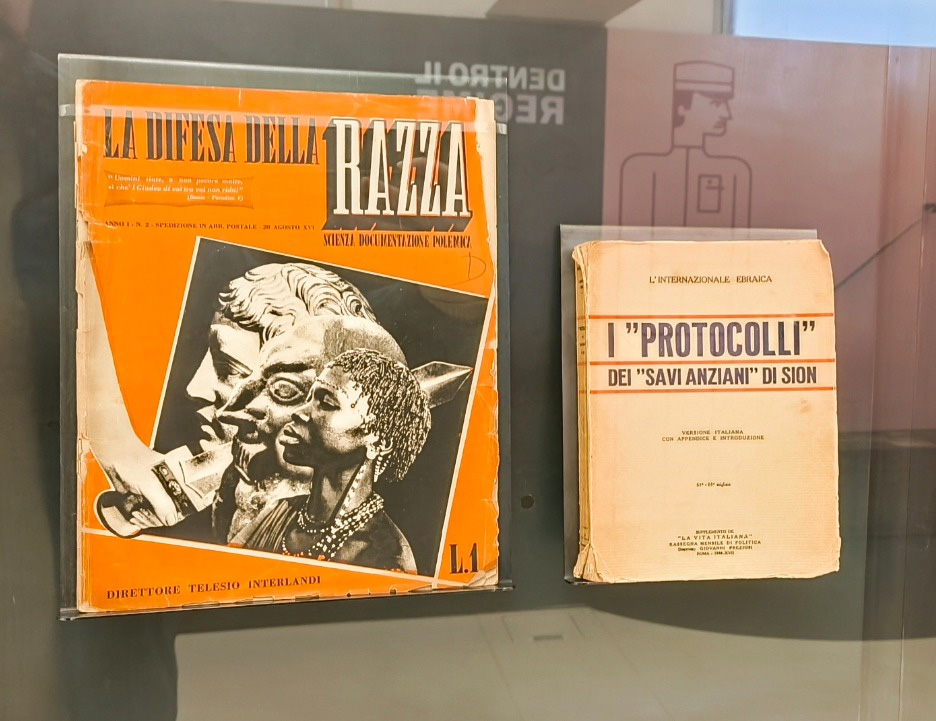
After such an extraordinary, artefact-rich and tangible journey through the centuries, one might expect an equally powerful and detailed treatment of Fascism and the Second World War. On the ground floor of the museum and in the Video Room, there is a permanent exhibition and multimedia component entitled 1938: L’umanità negata (1938: Humanity Denied), originally created to commemorate the 80th anniversary of the promulgation of the racial laws by Benito Mussolini’s regime.
This subject was particularly important to me, especially in the context of our project and its connection with Italy. I expected the museum to present the final stages of this historical journey with the same level of detail. Unfortunately, I have to be honest: this part of the museum proved deeply disappointing.
Why? The entire concept of the 1938 exhibition is based almost exclusively on visualizations and multimedia. The creators sought to construct what is presented as an “immersive experience.” We begin with a short film telling the story of two fictional families, one of them Jewish. As we move through a series of darkened rooms, we are surrounded by projections of contemporary propaganda newsreels, speeches by Fascist officials displayed on the walls, and digitized copies of newspapers and documents.
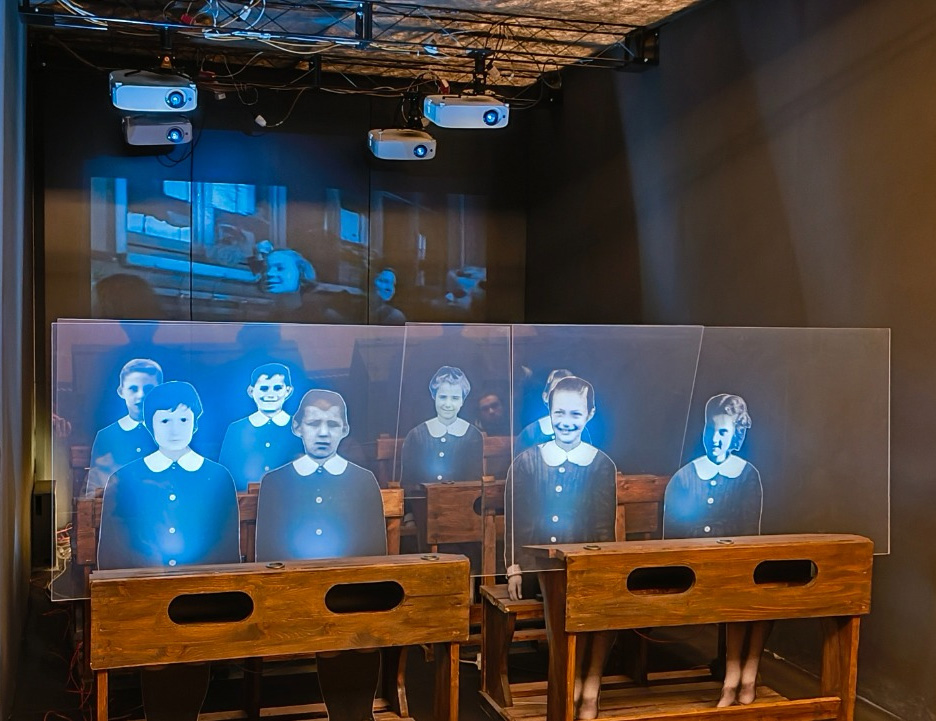
The problem is that, when contrasted with the first part of the museum, this multimedia section feels artificial and shallow. After seeing authentic objects more than a thousand years old, an exhibition consisting almost entirely of projectors, screens, speakers, and a somewhat formulaic message about European unity feels artificial. What is missing are authentic physical artefacts from the Holocaust era, personal belongings of the Jews deported from Ferrara, or even a larger number of original identity documents. Instead of the raw experience of the period, the museum offers a documentary film that could just as easily be watched at home on a television or computer screen. In a place intended to serve as a national memorial to the Italian Shoah, the absence of tangible relics from that period diminishes the experience and fails to produce the sense of unease that can accompany visits to places such as the POLIN Museum. This is particularly unfortunate because the museum as a whole creates a strong experience even for visitors who are not deeply familiar with the subject.
Is MEIS Worth Visiting?
Definitely… BUT.
If your travels ever take you to Emilia-Romagna, Ferrara and its National Museum of Italian Judaism and the Shoah are well worth a detour. The exhibition Ebrei, una storia italiana is an absolute masterpiece.
And the exhibition on the Second World War? Well, it is worth going through it to complete the historical timeline, but be aware of its format. It is a modern multimedia installation which, while historically sound in its basic approach, falls short in terms of emotional impact and authenticity.
Nevertheless, as a history enthusiast with a particular fascination for antiquity, the museum more than satisfied that particular hunger. And what comes next? Now it is time to head towards the Most Serene Republic of Venice.
Arrivederci!
Visit recounted by
Cristian Dumitrica